OVERVIEW
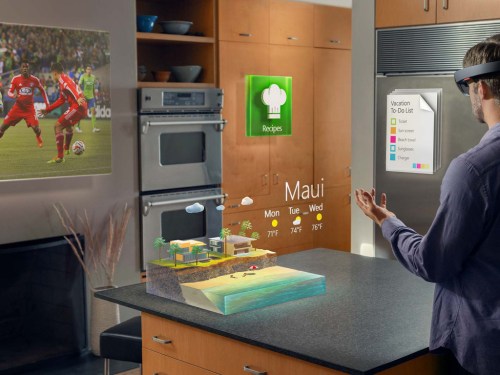
How Microsoft’s HoloLens would be used
Augmented Reality is experienced using a headset that overlays information, or digital images, over the user’s field of view. Augmented Reality (AR), also known as mixed reality, is thought to be a better technology than Virtual Reality because it does not require the use of screens – AR builds upon the real world environment around you.
WHY USE AR?
AR allows users to not be sucked into an alternate reality but instead use the headset to overlay the environment around them with informational tidbits that they can use to their advantage. Some examples include:
- Giving you walking directions on your way through the city
- Telling emergency responders the location of the nearest fire extinguisher
- Connecting names to faces when at a business mixer
- Playing a video game using real objects around you
CURRENT TECHNOLOGY
Three devices influencing the current application of AR are:
Google Glass and Microsoft’s HoloLens (which both incorporate digital overlays into the user’s eyes) and the Smartphone.
GOOGLE GLASS
Google Glass is a smart pair of eyeglasses introduced in 2012. It uses a small screen on one lens to deliver information into the corner of the user’s field of view. The glasses require a smartphone and contains a microphone to understand voice commands. Examples of applications with Google Glass are:
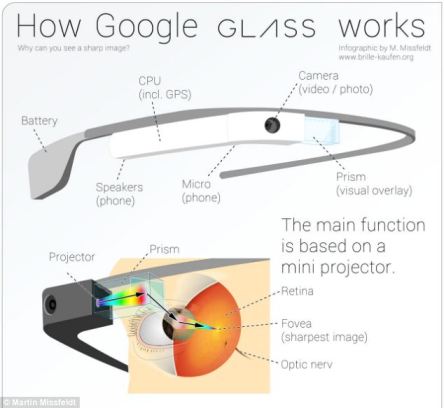
Diagram depicting components of Google Glass
- Facial recognition
- Language translation
- Photography
- Sharing to social media
- Notifications, alerts and reminders
- Maps and directions
- Media and video player
Although the device was seen as a success by many, Google has decided to halt manufacturing but remains committed to development. There are rumors that an upgraded version will be released in the near future thanks to an application submitted to the FCC in 2015.
MICROSOFT HOLOLENS
Microsoft’s first venture into the augmented reality world was back in 2010 with the Xbox’s Kinect motion sensing camera, an add on to the Xbox 360 gaming device. The system of camera sensors took visual input and overlaid it into a game. This allowed the gaming system to input your movements and voice commands into games such as Kinect Sports and Dance Central, where you became an in-game character.

Use HoloLens to create and visualize 3-D images
The next development after the Kinect is the HoloLens, a wireless headset that contains electronic displays that overlay digital data over the real life environment around you.
The HoloLens is responsive to the world around you by allowing the wearer to interact with content and information using gestures, gaze and voice commands. With this device, Microsoft expects wearers to not only augment the real world with helpful information but blend holograms with the real world and transport you into a virtual one!
This device is still in development but expect to see it in a Best Buy near you!
MOBILE
Using your smartphone as a window to the world around you adds important information to your surroundings.
Nowadays, the vast majority of smartphones have outward facing cameras which allow you to see the outside world through the screen.The screen itself is also capable of displaying virtual objects over physical ones.
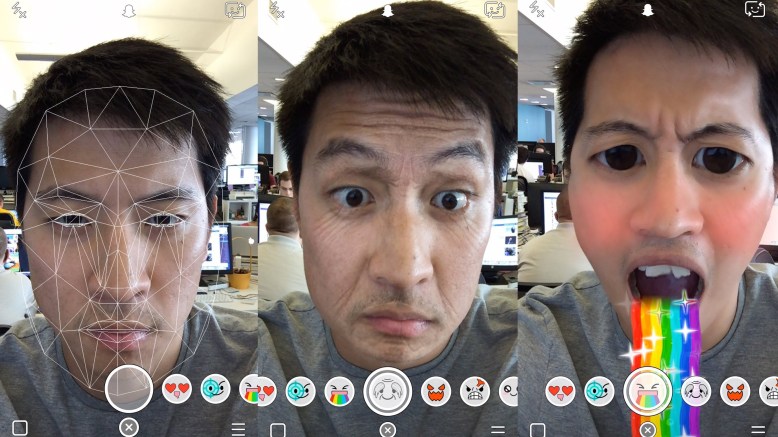
Snapchat filters artificially morphing a user’s face and features
One of the most popular smartphone applications on our devices that takes advantage of augmented reality is Snapchat, a photo-sharing application that allows you to overlay filters, costumes, and emoji’s over your pictures and videos.
Another application which has had immense virality is the new Pokémon Go! game. The
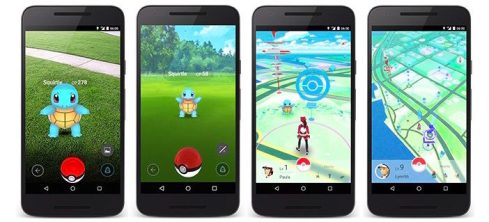
Pokemon Go! AR and map virtualization with gym and PokeStop locations
app overlays virtual creatures and gyms onto your surroundings. The popularity of the
game further demonstrates that people are willing to embrace augmented reality games into the mainstream.
Many scholars and professionals are looking into the implications of augmented reality and believe that it has already become the next platform for gaming and entertainment. Perhaps Pokémon Go! craze is not just a fad but a new niche to be explored.
References:
- Marshall, Patrick. “Virtual Reality.” CQ Researcher 26.9 (2016): n. pag. CQ Researcher Online [CQ Press]. Web. 27 June 2016.
- Eadicicco, Lisa. (2015, December). See the New Version of Google’s Wildest Product. TIME. Retrieved from http://time.com/4163067/google-glass-2-photos-2015/
- Singh, P., & Pandey, M. (2014). Augmented Reality Advertising: An Impactful Platform for New Age Consumer Engagement. IOSR Journal of Business and Management, 16(2), 24-28. http://dx.doi.org/10.9790/487x-16222428.
- Wafa, S.; Hashim, E. (2016) Adoption of Mobile Augmented Reality Advertisements by Brands in Malaysia. Procedia – Social and Behavioral Sciences, Volume 218, pp. 762-768.http://www.sciencedirect.com/science/article/pii/S1877042816301434
Word Count: 617
 Beyond the Wrist